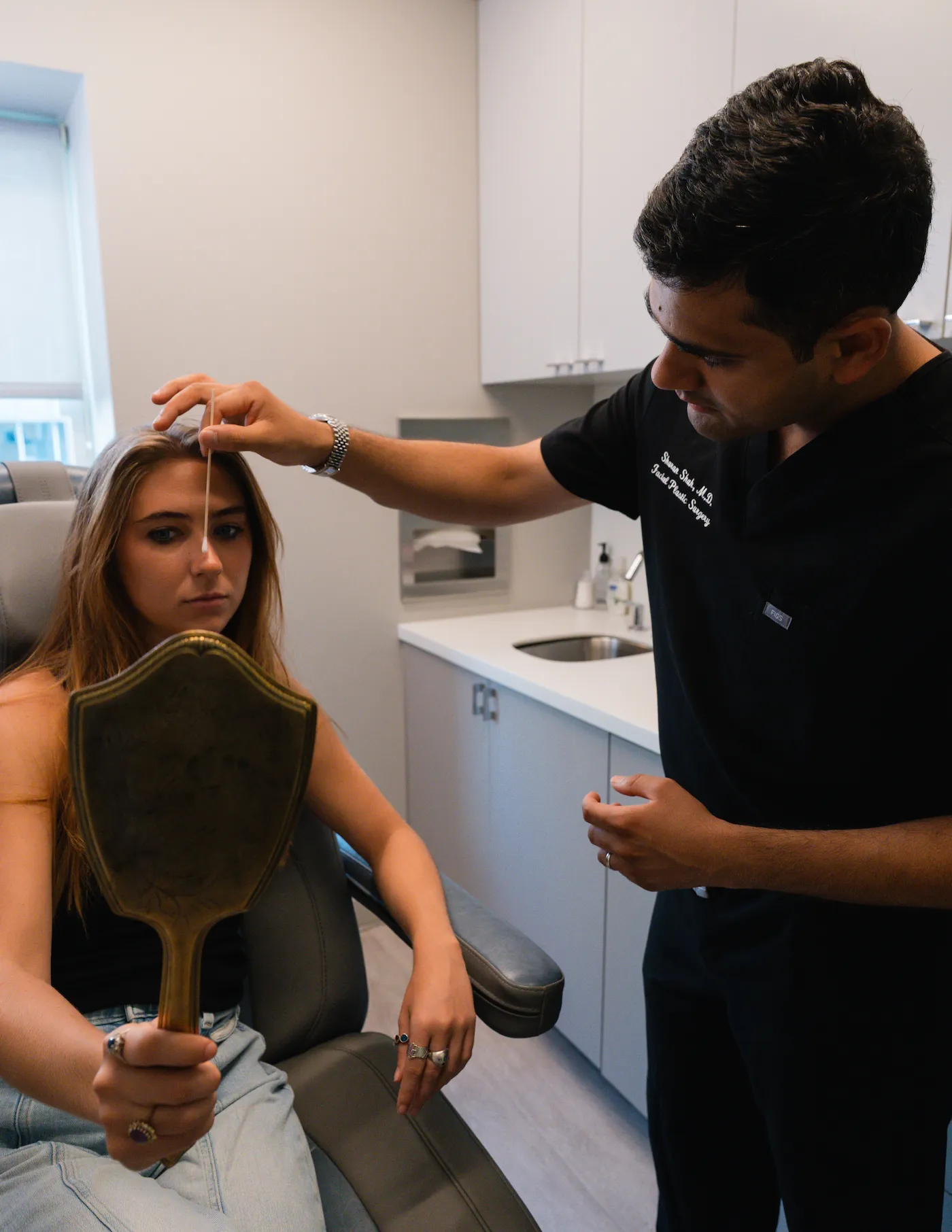
Rhinoplasty reshapes the nose to bring better balance and harmony to the face, whether the goal is refining the tip, straightening the bridge, or adjusting overall size and proportion. Because the nose is the central feature of the face, even small, precise changes can make a meaningful difference — the best results look natural, not "done," and reflect the patient's own features rather than a generic ideal.
Structural rhinoplasty reshapes the nose using the patient's own cartilage to reinforce and support the nasal framework, rather than removing tissue to create a smaller appearance. This approach is built to protect long-term nasal function and structural integrity, which means the results tend to hold up well over time and are less likely to shift, collapse, or require follow-up correction down the road.
Dr. Shah relies on structural technique as the foundation for most of his rhinoplasty work, using grafting to reinforce the tip and bridge so the nose stays strong and breathes well for years after surgery. It's an approach that favors durability and stability over shortcuts, and it reflects the same long-term thinking Dr. Shah brings to every case he takes on.
Preservation rhinoplasty is a modern approach that reshapes the nose by preserving the patient's natural ligaments and dorsum rather than separating and rebuilding them, as in more traditional techniques. In the ideal candidate, this produces a more natural-looking result with a smoother bridge contour, and it's often associated with less swelling and a more predictable and faster recovery.
Dr. Shah completed a dedicated fellowship focused specifically on preservation rhinoplasty, giving him hands-on, specialized training in this technique beyond general rhinoplasty training. Dr. Shah looks for patients who are good candidates for this approach and walks them through why it may — or may not — be the right fit, so the decision is thoughtful and tailored rather than one-size-fits-all.
Revision rhinoplasty addresses concerns left over from a previous surgery — whether that's a contour irregularity, breathing difficulty, or a result that simply didn't turn out as expected. These cases are more complex than a first-time rhinoplasty, often involving scar tissue, altered anatomy, and a need for additional cartilage grafting, which means they require a surgeon who can carefully diagnose exactly what happened and build a plan to correct it.
Revision cases are where meticulous planning matters most, and it's an area Dr. Shah takes particular care with, drawing on his Park Avenue training in complex rhinoplasty technique. Dr. Shah spends real time understanding what went wrong structurally and what the patient actually wants this time around, and together they move forward with a clear, realistic plan toward the outcome they were hoping for the first time.
Closed rhinoplasty is performed entirely through incisions hidden inside the nose, with no external incision across the columella. For the right candidates, this approach can mean less visible scarring, reduced swelling, and a quicker recovery, though it requires a surgeon comfortable working with a more limited view of the internal structures.
Working within that limited visibility demands precision and experience, both of which Dr. Shah built during his training with leading Park Avenue rhinoplasty surgeons, where the closed technique was used routinely. Dr. Shah takes the time upfront to determine whether a closed approach can achieve your specific goals, and he brings the same careful, unhurried attention to these cases as he does to any open procedure.
Ethnic rhinoplasty recognizes that noses of different heritages have distinct skin thickness, cartilage strength, and underlying bone structure, and that a good result should enhance a patient's features in a way that respects their heritage rather than erasing it. This is not a one-size-fits-all procedure — what works beautifully for one skin and cartilage type can fall flat, or even cause problems, for another.
Dr. Shah has spent significant time studying the nuances of ethnic nasal anatomy, with a particular focus on South Asian noses — including the thicker skin, softer cartilage, and structural patterns common in these patients, which change how grafting and shaping need to be approached. That focused understanding lets him set realistic expectations and tailor the surgical plan to features that are often underserved by more generic technique.
Functional rhinoplasty addresses breathing problems caused by structural issues inside the nose, such as a deviated septum or weak nasal valves, and it's often combined with cosmetic goals so patients can breathe better and feel confident about how their nose looks at the same time. Getting this balance right requires understanding both the airflow mechanics and the aesthetic outcome, not just one or the other.
Balancing form and function is a core part of Dr. Shah's rhinoplasty training, and he evaluates every patient for both breathing and cosmetic concerns from the first consultation, even when a patient comes in focused on only one. That dual focus, paired with the experience from doing hundreds of functional rhinoplasties in his head and neck surgical training, means the structural work Dr. Shah undertakes to improve your breathing is planned with your final aesthetic result in mind, and vice versa.
